
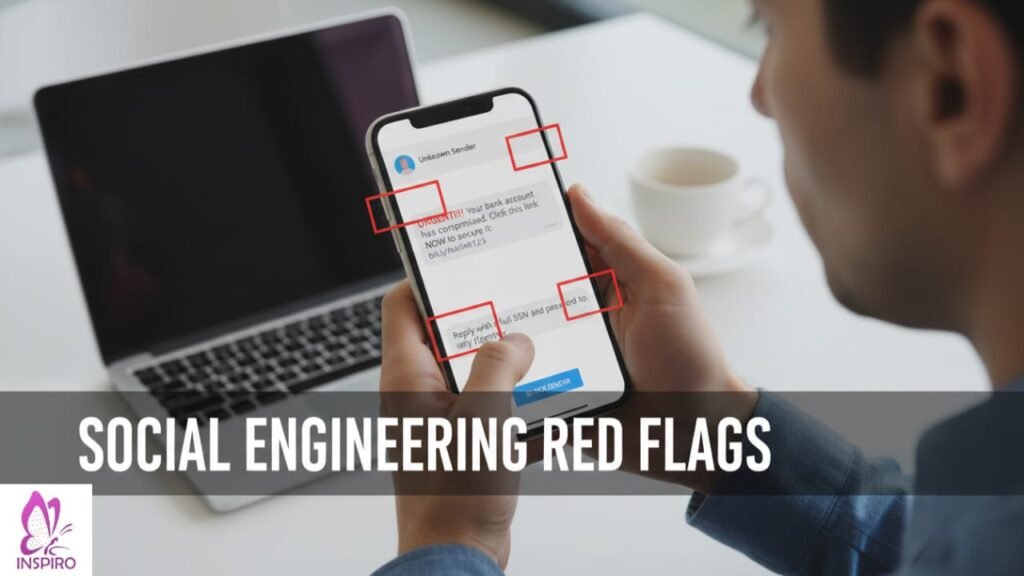
Imagine this:
You get a message from “your bank,”
the logo looks real,
the tone feels urgent,
and the link looks… almost right.
Your brain says “Something is off.”
But you can’t explain what — and that’s exactly how social engineers win.
Social engineering attacks work because they hack people, not computers.
And unless you know what to look for, you’ll fall for the same traps millions fall for every year.
This guide will show you how to spot social engineering in 3 seconds — using simple psychological cues anyone can learn.
Whether you’re a beginner, a corporate employee, or someone just trying to stay safe online, this is your survival guide.
What Is Social Engineering? (And Why It Works So Well)
Social engineering is a type of cyberattack that tricks people into giving away information, money, or access.
Hackers don’t break in — they manipulate in.
They pretend to be:
- your bank
- your HR department
- your cloud service
- your IT support
- your friend
- even your boss
It works because the human brain responds faster to emotion than logic.
And attackers know exactly which emotion to target.
The 3-Second Rule: How to Spot Social Engineering Instantly
When you receive any message — email, WhatsApp, SMS, call, or DM — ask yourself these 3 questions immediately.
If ONE feels off, it’s social engineering.
1️⃣ Does it create sudden URGENCY?
If you feel pressured to act right now, pause.
Hackers create panic because panic kills judgment.
Urgency phrases to watch for:
- “Your account will be closed in 24 hours.”
- “Final warning.”
- “Immediate action required.”
- “Click to avoid suspension.”
- “Your package is stuck.”
Real organizations don’t threaten you with deadlines. Social engineers do.
2️⃣ Does it ask for something UNEXPECTED?
If the message asks for:
- passwords
- login codes
- payment details
- card numbers
- verification links
- personal data
- remote access
…it’s fake.
Legitimate companies NEVER ask for sensitive details through messages.
Unexpected request = social engineering.
3️⃣ Does something LOOK slightly unusual? (Even if you can’t explain it)
Most attacks fail not because people are smart —
but because something felt wrong.
Common red flags:
- The sender’s email address is misspelled.
- The logo looks low quality.
- The writing tone doesn’t match the real company.
- The link is slightly different (e.g., paypaI.com instead of paypal.com).
- The message sounds robotic or too “urgent.”
Your brain notices inconsistencies before you do.
If something feels off…
stop.
That feeling is your 3-second warning.
The Psychology Hackers Use (Know This and You Become Unhackable)
Every social engineering attack uses one of these psychological triggers:
- Fear → “Your account will be locked.”
- Urgency → “Payment must be made in 10 minutes.”
- Authority → “This is IT support.”
- Greed → “You’ve won $5000!”
- Curiosity → “Is this you in this video?”
- Trust → “Hey, it’s your boss.”
When you can recognize the trigger, you’ll recognize the scam.
Real Examples You’ll See Every Day
Email example:
“Your Microsoft 365 password expires today. Click to update.”
🚩 Urgency
🚩 Unexpected request
🚩 Link mismatch
WhatsApp example:
“Please send the 6-digit code we sent to your phone. It was sent by mistake.”
🚩 Code requests = always social engineering
🚩 Impersonation attempt
Phone call example:
“This is your bank. We detected suspicious activity.”
🚩 Banks NEVER do unsolicited verification by phone
🚩 Caller ID can be fake
The Golden Rule of Anti-Scam Safety
If you didn’t ask for it, don’t trust it.
That rule alone protects you from 90% of attacks.
Want to Learn More? Join Inspiro’s Cyber Security With AI Training
If you want to:
✔ Recognize advanced social engineering
✔ Learn phishing detection
✔ Train your brain to identify cyber threats
✔ Become security-aware at work and at home
✔ Boost your career in cybersecurity
Then join our Cyber Security With AI course at Inspiro Technology Ltd.
We include:
– Hands-on cybersecurity labs
– Social engineering simulations
– Real-world phishing breakdowns
– Corporate-level cyber awareness
– Career guidance & interview prep
👉 Enroll now and stay ahead of cyber criminals.
www.inspirotechacademy.co.uk
Final Thoughts
Social engineering is not a technology problem.
It’s a human problem.
But with the right knowledge, you can spot attacks in seconds — and protect yourself before damage happens.
Stay alert. Stay informed. Stay secure.